Cox is now Spectrum
Effective September 16, 2026, Cox internet is offered under Spectrum's pricing and packaging: Spectrum Internet® 100, 500 and 1 Gig, with 2 Gig in select markets. Existing Cox customers keep their current service and account until Spectrum notifies them of any change. Prices shown are for new residential customers for 1 year.
Source: Spectrum Product Marketing Guidelines for Digital Partners (August 17, 2026); Cox transition notice, August 20, 2026. Checked September 16, 2026. cox.com/residential/cox-is-now-spectrum.html
INTERNET OFFER: Limited-time offer; subject to change; new residential customers only (no Spectrum service in past 30 days). Standard rates apply after promo period or service change. Actual speeds (including wireless) vary and are not guaranteed. Activation fee additional; taxes may apply. Gig speeds require a compatible modem; see Spectrum.net/modem for list. Terms and conditions apply, subject to change. Not available in all areas. Restrictions apply. Spectrum Internet® is powered by fiber and connected to the premises by coaxial lines.
Data caps are one of the most misunderstood aspects of home internet service. Some providers impose monthly limits on how much data you can use, while others offer truly unlimited service. If you've ever received an overage charge or noticed your speeds throttled near the end of the month, a data cap was likely the culprit.
Here's everything you need to know about internet data caps: which providers have them, which don't, how much data you actually use, and how to avoid unexpected charges.
What Are Internet Data Caps?
A data cap (also called a data allowance or usage limit) is a monthly limit on the total amount of data you can download and upload through your internet connection. Data caps are measured in gigabytes (GB) or terabytes (TB). When you exceed your cap, your provider may charge overage fees, throttle your speeds, or both.
Data caps exist because providers claim they help manage network congestion by discouraging extremely heavy usage. Consumer advocates argue that data caps are primarily a revenue tool, since the marginal cost of delivering additional data over existing infrastructure is minimal.
Which Providers Have Data Caps?
Providers with Data Caps
Xfinity (Comcast): Most Xfinity plans include a 1.2 TB monthly data cap. If you exceed it, Xfinity charges $10 per additional 50 GB, up to a maximum of $100 in overage fees per month. You can add unlimited data for $30/month or upgrade to a plan that includes it. Xfinity does not enforce the cap in the Northeast (formerly Charter territory) due to merger conditions.
Overages are charged at $10 per 50 GB with a $100 monthly maximum.
HughesNet: As a satellite provider, HughesNet has historically imposed strict data caps (15–100 GB depending on plan). Their newer plans offer more generous allowances, but satellite internet remains the most data-restricted category.
Viasat: Viasat's plans include data priority thresholds. Once you exceed your priority data (40–300 GB depending on plan), speeds may be reduced during times of network congestion. They don't charge overage fees but the speed reduction can be significant.
Mediacom: Data allowances range from 600 GB to 6 TB depending on the plan tier, with $10/50 GB overages.
Providers Without Data Caps
Spectrum: Spectrum has no data caps on any plan. This is a legacy of the conditions placed on Charter Communications when it merged with Time Warner Cable in 2016. Those conditions have technically expired, but Spectrum has continued the no-cap policy.
T-Mobile 5G Home Internet: T-Mobile does not impose data caps on its home internet plans. However, home internet customers may be deprioritized during times of network congestion.
Frontier Fiber: Frontier's fiber plans come with no data caps. As Frontier has upgraded its network from DSL to fiber, it has positioned itself as a no-cap, no-contract alternative to cable.
Google Fiber: No data caps on any plan. Google Fiber's 1 Gbps and higher plans offer unlimited data as a standard feature.
Verizon Fios: Verizon's fiber service has never had data caps.
AT&T Fiber: AT&T removed data caps from all its fiber plans. However, AT&T's legacy DSL and fixed wireless plans may still have limits.
Ziply Fiber: No data caps on any plan.
Starlink: No hard data cap on the residential plan. Priority plans have priority data thresholds after which speeds may be reduced during congestion, but there are no overage charges.
How Much Data Do Common Activities Use?
To understand whether a data cap affects you, it helps to know how much data your activities consume:
| Activity | Data Usage Per Hour | Hours to Hit 1.2 TB |
|---|---|---|
| Web browsing | ~0.06 GB | ~20,000 hours |
| ~0.01 GB | ~120,000 hours | |
| Social media scrolling | ~0.15 GB | ~8,000 hours |
| Music streaming (Spotify, Apple Music) | ~0.15 GB | ~8,000 hours |
| SD video streaming (480p) | ~0.7 GB | ~1,714 hours |
| HD video streaming (1080p) | ~3 GB | ~400 hours |
| 4K video streaming | ~7 GB | ~171 hours |
| Video calls (Zoom/Teams) | ~1.5 GB | ~800 hours |
| Online gaming | ~0.06 GB | ~20,000 hours |
| Game downloads (AAA title) | 50–150 GB per game | 8–24 games |
| OS/software updates | 1–10 GB per update | varies |
For context, a 1.2 TB cap means you could stream about 400 hours of HD video per month (roughly 13 hours per day). Most single-person or couple households won't come close to 1.2 TB. However, families with multiple 4K TVs, gamers who download large titles regularly, and remote workers who transfer large files can exceed 1 TB more easily than you might think.
How to Check Your Data Usage
Most ISPs provide usage tracking through their account portal or app:
- Xfinity: Log in to xfinity.com/usage or the Xfinity app to see current month usage and daily breakdowns
- Cox: Check usage at cox.com/internettools/usage or the Cox app
- Other providers: Log into your account online or check your provider's app for data usage meters
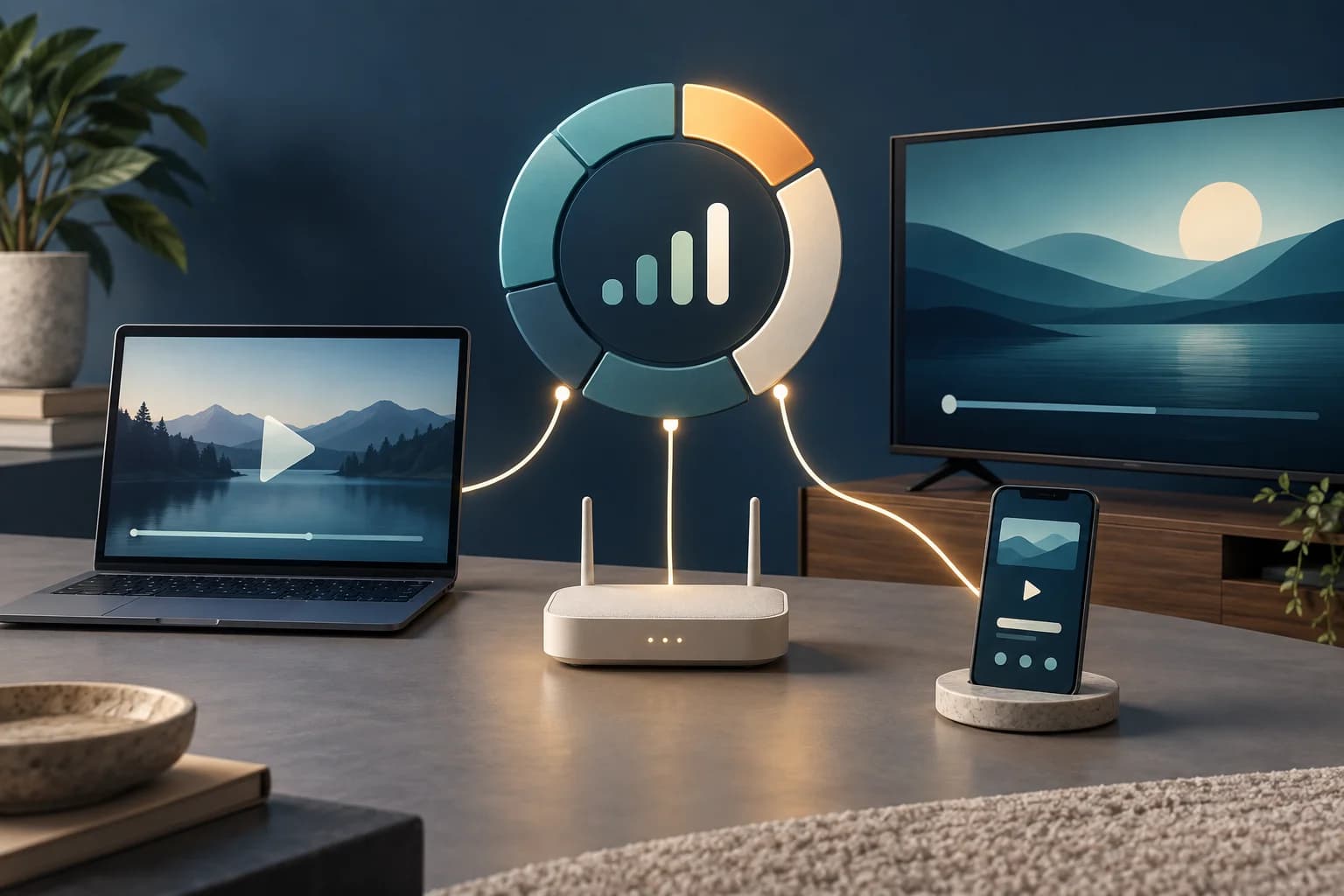
You can also monitor data usage at the router level. Many modern routers (especially mesh systems) track per-device data usage, helping you identify which devices consume the most data. This is useful for pinpointing unexpected data hogs.
How to Reduce Your Data Usage
If you're approaching your data cap, here are practical ways to cut consumption:
Adjust Streaming Quality
Streaming video is the largest data consumer in most homes. Reducing Netflix from 4K to HD cuts data usage by more than half. Most streaming services let you set a default quality level in their settings. On devices where you won't notice the difference (phones, tablets, small TVs), streaming in HD instead of 4K saves significant data.
Disable Auto-Play and Autodownloads
Social media apps and streaming services auto-play videos as you scroll or queue up the next episode. Disabling these features reduces passive data consumption. Also check for automatic cloud backups (photos, videos) that may be uploading large files continuously.
Schedule Large Downloads
Game downloads, OS updates, and cloud backups can be scheduled for overnight hours. While this doesn't reduce total usage, some providers (like HughesNet) offer bonus data during off-peak hours that doesn't count toward your cap.
Monitor Connected Devices
Smart home cameras (especially those recording continuously to the cloud), security systems, and forgotten devices can consume data in the background. Review your connected devices and disable data-heavy features on devices that don't need them.
What to Do If You Keep Hitting Your Cap
If you consistently exceed your data cap, you have several options:
- Add unlimited data: If your provider offers an unlimited add-on ($30–50/month), this may be cheaper than overage fees
- Upgrade your plan: Higher-tier plans sometimes include larger or unlimited data allowances
- Switch providers: If a no-cap provider like Spectrum, Frontier, or T-Mobile serves your area, switching eliminates the problem entirely
- Use your provider's own streaming: Some ISPs don't count their own streaming services (like Xfinity's Peacock) against your cap (a practice known as zero-rating)
For provider options without data restrictions, see our guide to no-contract internet plans.
The Future of Data Caps
Data caps remain controversial. The FCC has periodically examined the practice, and consumer advocacy groups continue to push for their elimination. Competition from fiber and 5G providers—most of which don't impose caps—is slowly pressuring cable companies to raise or eliminate their limits.
As fiber and 5G networks expand, consumers in more markets will have cap-free alternatives, which may eventually force remaining providers to drop caps to stay competitive.
Which Providers Have Data Caps in 2026?
Data cap policies vary significantly across providers. Here is the current landscape:
Providers WITH Data Caps
- Xfinity: 1.2 TB cap in most markets (Northeast exempt). Overage: $10 per 50 GB block, $100/month max. Unlimited add-on: $30/month or $25/month with xFi Complete.
- Overage: $10 per 50 GB block, $100/month max. Unlimited add-on: $49.99/month (one of the most expensive).
- Mediacom: Caps range from 200 GB to 6 TB depending on plan tier. Overage: $10 per 50 GB block.
- HughesNet (satellite): Plans include 15-100 GB of priority data, after which speeds are reduced (not charged per GB, but throttled).
Providers WITHOUT Data Caps
- AT&T Fiber: No data cap on any fiber plan
- Verizon Fios: No data cap
- Frontier Fiber: No data cap
- Spectrum: No data cap
- T-Mobile Home Internet: No hard data cap (may deprioritize during congestion)
- Google Fiber: No data cap
- Quantum Fiber (CenturyLink): No data cap on fiber plans
How Much Data Does Your Household Actually Use?
Understanding your data consumption helps you determine if a data cap will affect you:
- Average US household: Uses approximately 500-600 GB per month according to industry reports.
- Heavy streaming household (cord-cutters): A household replacing cable TV with streaming services typically uses 800-1,500 GB per month. 4K streaming is the primary driver — Netflix in 4K uses approximately 7 GB per hour.
- Gamer household: Modern game downloads (50-150 GB each) plus regular updates (10-30 GB/month per game) add up quickly. A household with two active gamers downloading 3-4 new titles per month could use 500-800 GB just on game downloads.
- Remote work household: Video calls use 1-2 GB per hour. Cloud file sync adds 5-50 GB per month. Remote work alone rarely pushes you over a 1.2 TB cap, but combined with streaming and gaming, it can tip the balance.
How to Reduce Data Usage Without Sacrificing Quality
If you are on a capped plan and want to avoid overage charges, these strategies can significantly reduce your data consumption:
- Lower streaming resolution: Switching from 4K to HD (1080p) reduces data usage by approximately 75% per stream — from 7 GB/hour to 1.5-3 GB/hour. On most TVs under 55 inches, the visual difference is negligible from normal viewing distances.
- Disable auto-play and pre-loading: Streaming services often pre-load the next episode or suggested content before you select it. Disable auto-play in Netflix, YouTube, and other services to prevent data usage on content you may not watch.
- Schedule game downloads: If your ISP's cap is measured monthly, plan large game downloads for the beginning of the billing cycle when you have full headroom. Some providers offer off-peak hours where data usage does not count toward caps (check with your provider).
- Use app-specific data settings: Most streaming apps let you set a preferred quality. Set Netflix, YouTube, and other services to "Auto" or "HD" rather than "4K Ultra HD" to let the app optimize quality based on your screen size and connection.
- Monitor usage weekly: Check your ISP's usage meter every week rather than waiting until the end of the month. This gives you time to adjust habits if you are trending toward exceeding your cap.
If data caps are a recurring problem, the most effective solution is switching to a provider without caps. See our address lookup tool for cap-free options at your address.
Frequently Asked Questions
Is 1.2 TB enough data for a household?
For most households, yes. The average U.S. household uses roughly 500–600 GB per month according to industry reports. However, households that stream 4K content on multiple devices, download large games frequently, or have multiple remote workers may exceed 1.2 TB. If you're unsure, check your current usage through your provider's portal before assuming you need unlimited.
Do data caps apply to upload and download?
Yes. Your data cap includes both data you download (streaming, browsing, downloading files) and data you upload (video calls, cloud backups, uploading content). Both directions count toward your monthly allowance.
Can my ISP slow my internet if I don't have a data cap?
Even without a formal data cap, some providers include terms allowing them to deprioritize extremely heavy users during periods of network congestion. This is different from throttling—your speeds are reduced only when the network is busy and only relative to other users. In practice, this rarely affects normal household usage.
Why don't fiber providers have data caps?
Fiber optic networks have far greater capacity than cable or satellite networks. The cost of delivering additional data over fiber infrastructure is minimal, making data caps unnecessary from a technical standpoint. Fiber providers also use the lack of data caps as a competitive differentiator against cable companies.
What happens if I go over my data cap?
It depends on your provider. Xfinity and Cox charge $10 per additional 50 GB (up to $100/month maximum). Some providers throttle your speeds instead of charging fees. Others send warnings for the first occurrence and begin charging with subsequent overages. Check your provider's specific overage policy in your service agreement.
Can I dispute data cap overage charges?
You can contact your provider to dispute charges if you believe their data meter is inaccurate. Some providers offer a one-time courtesy credit for first-time overages. If you consistently disagree with reported usage, install a third-party monitoring tool on your router to compare against your ISP's numbers.
Sources & Methodology
This article uses data from FCC Broadband Data Collection reports, U.S. Census Bureau demographics, and verified provider pricing and plan information. Pricing, speeds, and availability are verified against provider broadband nutrition labels and may vary by location. For a detailed explanation of our data collection and scoring process, see our methodology page.
Data Sources
- FCC Broadband Data Collection
- U.S. Census Bureau American Community Survey
- USAC Universal Service Fund
- NTIA Internet Use Survey
Last verified: March 2026. InternetProviders.ai is an independent resource. We may earn commissions from partner links — this does not affect our editorial recommendations. See our methodology for details.