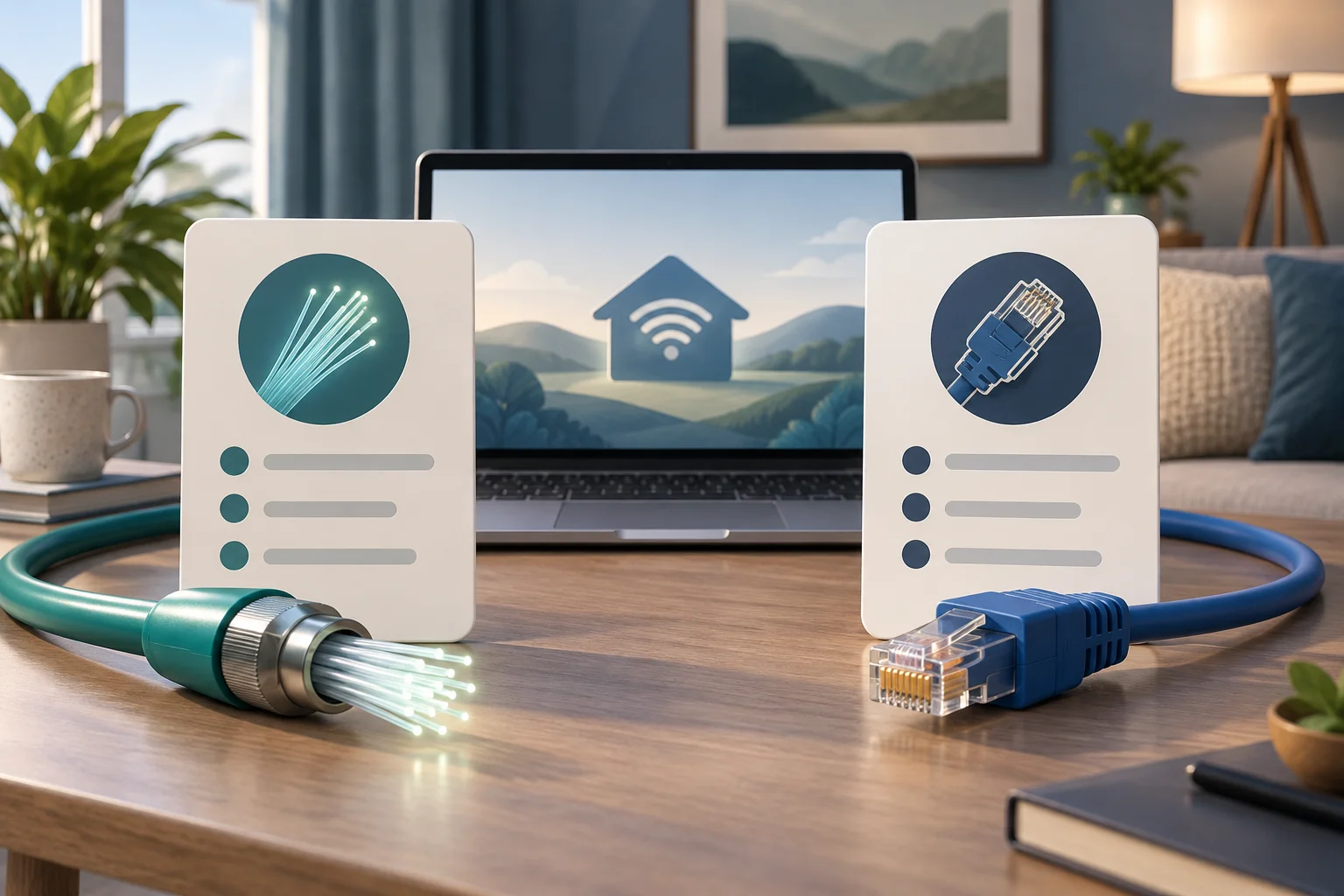
Spectrum and AT&T are two of the most widely available internet providers in the United States, together covering more than 150 million households. But they deliver internet through fundamentally different technologies—Spectrum uses cable (HFC), while AT&T’s flagship product is fiber-optic (FTTH). This comparison examines every dimension that matters: plans, pricing, speed performance, reliability, coverage, customer satisfaction, and total cost of ownership.
Quick Comparison Summary
| Category | Spectrum | AT&T Fiber | Winner |
|---|---|---|---|
| Technology | Cable (DOCSIS 3.1) | Fiber (FTTH) | AT&T |
| Long-Term Price | $79.99/mo (after promo) | $55.00/mo (price lock) | AT&T |
| Download Speeds | 300–1,000 Mbps | 300–5,000 Mbps | AT&T |
| Upload Speeds | 10–35 Mbps | 300–5,000 Mbps | AT&T |
| Data Caps | None | None (fiber) | Tie |
| Contract Required | No | No | Tie |
| Coverage | 41 states, ~59M homes | 21 states, ~28M homes (fiber) | Spectrum |
| Latency | 18–25 ms | 5–12 ms | AT&T |
| Customer Satisfaction (ACSI) | 63/100 | 68/100 | AT&T |
Plans and Pricing Compared
Spectrum Plans
| Plan | Speed (Down/Up) | Promo Price | Regular Price |
|---|
AT&T Fiber Plans
| Plan | Speed (Symmetric) | Price (Locked) |
|---|---|---|
| Internet 1000 | 1,000/1,000 Mbps | $80.00/mo |
The Pricing Math: Short-Term vs. Long-Term
| Period | Spectrum 300 | AT&T Fiber 300 | Savings |
|---|---|---|---|
| Year 1 | $599.88 | $660.00 | Spectrum saves $60 |
| Year 2 | $959.88 | $660.00 | AT&T saves $300 |
| Year 3 | $959.88 | $660.00 | AT&T saves $300 |
| 3-Year Total | $2,519.64 | $1,980.00 | AT&T saves $539.64 |
The first-year savings of $60 with Spectrum are quickly overwhelmed by the post-promotional increase. By month 18, AT&T Fiber has already made up the difference and continues to save money every month thereafter. Add Spectrum’s $5/month router rental (AT&T includes the gateway free) and the gap widens further.
Speed Performance: Cable vs. Fiber
The most significant performance difference between these providers is upload speed. AT&T Fiber delivers symmetric speeds (upload equals download), while Spectrum’s cable technology severely limits uploads due to the fundamental architecture of DOCSIS cable technology.
| Activity | Spectrum 300 (10 Mbps up) | AT&T Fiber 300 (300 Mbps up) |
|---|---|---|
| Upload 20 GB video to YouTube | ~4.4 hours | ~9 minutes |
| Backup 5 GB photos to cloud | ~67 minutes | ~2 minutes |
| Zoom HD video quality | Adequate (1 call) | Excellent (10+ calls) |
| Twitch streaming at 1080p | Borderline (uses 60%+ of upload) | Effortless (<3% of upload) |
This difference matters for video conferencing (upload your video feed at 2–5 Mbps per call), cloud backups (10–30x faster on fiber), content creation (uploading videos and publishing large files), and smart home cameras that upload footage to the cloud at 2–5 Mbps each. In a household with two remote workers on simultaneous video calls, Spectrum’s 10 Mbps upload is already near capacity, while AT&T’s 300 Mbps has barely been touched.
Reliability and Downtime
Fiber-optic connections are inherently more reliable than cable for several technical reasons:
- No shared bandwidth: Fiber provides a dedicated connection from the central office to your home. Cable shares bandwidth among all users on a local node, leading to congestion during peak hours.
- Immune to interference: Fiber-optic cables transmit light through glass, making them immune to electromagnetic interference from appliances, power lines, and weather.
- Weather resilience: Fiber is less susceptible to weather-related outages than cable, which can be affected by water intrusion in coaxial connections.
- Consistent peak-hour performance: AT&T Fiber maintains 99–101% of advertised speeds during peak hours. Spectrum drops to 92–95% during the same period.
AT&T Fiber’s reported uptime exceeds 99.9% in most markets. Spectrum’s cable service averages 99.5–99.8% uptime, with occasional outages during severe weather or peak congestion events. The difference equates to roughly 4–17 additional hours of downtime per year on cable.
Coverage: Where Each Provider Is Available
Spectrum has significantly broader coverage, serving approximately 59 million homes across 41 states. AT&T Fiber reaches approximately 28 million homes across 21 states, concentrated in metropolitan areas in Texas, California, Florida, Georgia, and the Southeast.
This coverage gap is the primary reason many people end up with Spectrum—it is simply the only high-speed option at their address. In areas where both providers are available, AT&T Fiber is the superior choice on nearly every technical metric. Use our availability checker to see which providers serve your address.
For detailed coverage breakdowns, see our Spectrum coverage guide and AT&T Fiber availability guide.
Customer Satisfaction
Neither provider leads the industry in customer satisfaction, but AT&T Fiber consistently outscores Spectrum in major surveys. Fiber providers generally receive higher scores because of fewer service interruptions, more consistent speeds, and transparent pricing.
| Survey | AT&T Fiber | Spectrum | Industry Avg | Leader |
|---|---|---|---|---|
| ACSI 2025 | 68/100 | 63/100 | 65/100 | Verizon Fios (72) |
| J.D. Power 2025 | 710/1000 | 668/1000 | 695/1000 | Google Fiber (742) |
Common complaints about Spectrum center on post-promotional price increases and upload speed limitations. AT&T Fiber complaints tend to focus on availability limitations and the mandatory gateway device.
Equipment Comparison
| Equipment | Spectrum | AT&T Fiber |
|---|---|---|
| Modem/Gateway | Free DOCSIS 3.1 modem | Free WiFi 6/6E/7 gateway |
| WiFi Router | $5/mo rental (or BYO) | Built into gateway (free) |
| Installation | $59.99 pro / free self-install | Free professional install |
| Use Own Router | Yes (router only) | Yes (via IP passthrough) |
AT&T Fiber’s all-inclusive equipment policy saves $60+/year compared to Spectrum if you rent the Spectrum router, plus installation is always free on fiber. However, AT&T requires use of their gateway device, which some power users find limiting.
Our Verdict
Choose AT&T Fiber if: You have fiber availability at your address, need symmetric upload/download speeds, want a price-locked rate with no promotional expiration, or prioritize low latency for gaming. AT&T Fiber is the superior product in every technical dimension and the better long-term value.
Choose Spectrum if: AT&T Fiber is not available in your area, you want the cheapest possible first-year price and plan to negotiate at month 13, or you prefer the flexibility of a self-install setup without scheduling a technician visit. Spectrum’s no-data-cap policy also matters if your alternative is a capped cable provider.
Frequently Asked Questions
Is AT&T Fiber better than Spectrum?
In terms of technology and long-term value, yes. Fiber delivers faster upload speeds, lower latency, more consistent performance, and a better price over 2+ years. However, Spectrum may be the better practical choice if fiber is not available at your address or if the lower first-year price matters more than long-term savings.
Can I get both Spectrum and AT&T at my address?
Many addresses in AT&T Fiber markets also have Spectrum cable service available. Use our availability checker to see all providers at your address and compare options.
Does Spectrum or AT&T have data caps?
Neither Spectrum nor AT&T Fiber have data caps. However, AT&T’s legacy DSL plans may have a 1 TB cap in some areas, and the AT&T Internet Air (fixed wireless) service also has no cap.
Which is better for gaming: Spectrum or AT&T?
AT&T Fiber is better for gaming due to lower latency (5–12 ms vs. 18–25 ms) and symmetric speeds that benefit both downloading game updates and uploading gameplay data. For competitive FPS gaming, the latency difference is noticeable. See our Spectrum gaming guide and AT&T Fiber review for detailed gaming analysis.
Which is better for working from home?
AT&T Fiber. The symmetric upload speeds mean video conferencing, cloud file sync, VPN connections, and collaborative tools all perform significantly better. Two remote workers in the same household can easily saturate Spectrum’s 10 Mbps upload but barely touch AT&T Fiber’s 300 Mbps.
Prices and availability vary by location. Check your address for current offers from both providers. See our methodology for comparison criteria.
Switching from Spectrum to AT&T Fiber
If you currently have Spectrum and AT&T Fiber has become available at your address, here is how to make a smooth transition:
- Verify AT&T Fiber availability. Use our availability checker to confirm fiber (not just DSL or Internet Air) is available at your specific address.
- Order AT&T Fiber and schedule installation. AT&T typically schedules installation within 3–7 days. You can schedule during the day while Spectrum is still active.
- Keep Spectrum active during the transition. Do not cancel Spectrum until AT&T Fiber is installed, tested, and working. The 1–2 week overlap costs one extra partial month of Spectrum but prevents any internet gap.
- Test AT&T Fiber thoroughly. Run speed tests, verify upload speeds are symmetric, test video conferencing, and ensure all devices connect properly before canceling Spectrum.
- Cancel Spectrum and return equipment. or visit a Spectrum store. Return the modem and router within 15 days to avoid equipment charges.
- Enjoy the savings. Your AT&T Fiber price-locked rate means no more annual calls to Spectrum retention to negotiate your bill down.
When Spectrum Is the Better Choice
Despite AT&T Fiber’s technical superiority, there are legitimate scenarios where Spectrum makes more sense:
- No fiber availability: The most common reason. If AT&T Fiber does not serve your address, Spectrum is often the fastest wired option available. Cable at 300–1,000 Mbps download is excellent, even with limited uploads.
- Self-installation preference: Spectrum offers free self-installation kits, while AT&T Fiber requires a professional technician visit. If you do not want to schedule a 2–4 hour appointment window, Spectrum’s DIY setup is more convenient.
- Cable TV bundling: If you want traditional cable TV service, Spectrum’s internet+TV bundles may offer better value than separate AT&T internet and a streaming TV service.
Pros and Cons
Spectrum
Pros
- No data caps on any plan
- No annual contracts required
- Fiber technology available with symmetric speeds
- Wide availability across 41 states
Cons
- Upload speeds vary by plan and technology
AT&T
Pros
- No data caps on any plan
- No annual contracts required
- Fiber technology available with symmetric speeds
- Speeds up to 5 Gbps
Cons
- Limited to 21 states
- Upload speeds vary by plan and technology
Sources
This content references data from FCC Broadband Map, U.S. Census Bureau. Pricing and availability are subject to change.
Market Context
The broadband market concentration in the United States varies based on population density and infrastructure investment. According to FCC broadband deployment data, median household income and population density are key factors in service availability and pricing. The BEAD (Broadband Equity, Access, and Deployment) program may expand options in underserved areas of the United States.
Urban, Suburban, and Rural Availability
Your location determines which provider you can get — and often which technology tier. Here is how Spectrum and AT&T coverage breaks down by area type:
Urban Areas
Both providers offer their best service in urban markets. AT&T Fiber availability is highest in major cities (Dallas, Houston, Atlanta, Chicago, Nashville), where fiber infrastructure deployment is economically viable. Spectrum's cable network covers most urban and suburban areas in its 41-state footprint. In cities where both are available, AT&T Fiber typically wins on speed and upload performance.
Suburban Areas
Suburbs present a mixed picture. Newer suburban developments often have AT&T Fiber installed during construction. Older suburbs may only have AT&T DSL (much slower, max 100 Mbps) or no AT&T service at all. Spectrum's cable network extends into most suburban areas, making it the more consistently available option.
Rural Areas
Neither provider is strong in rural markets. Spectrum's cable network reaches some small towns, while AT&T's rural footprint is primarily DSL. If you are in a rural area without cable or fiber access, alternatives include T-Mobile 5G Home Internet ($50/mo, available in many areas), Starlink ($120/mo, available nearly everywhere), or your local fixed wireless provider.